« The Israeli Army has become an army of militias »
Assaf David is a professor at the Hebrew University of Jerusalem and a research fellow at the Van Leer Institute (also in Jerusalem) specialising in the armies of the Middle East. Born in a religious settlement, he spent 11 years three decades ago in unit 8-300 of the Israeli army, a unit specializing in technological intelligence.
In this interview with Orient XXI, he talks about the evolution of the Israeli army, but also about that of the country’s society as a whole since 7 October 2023.
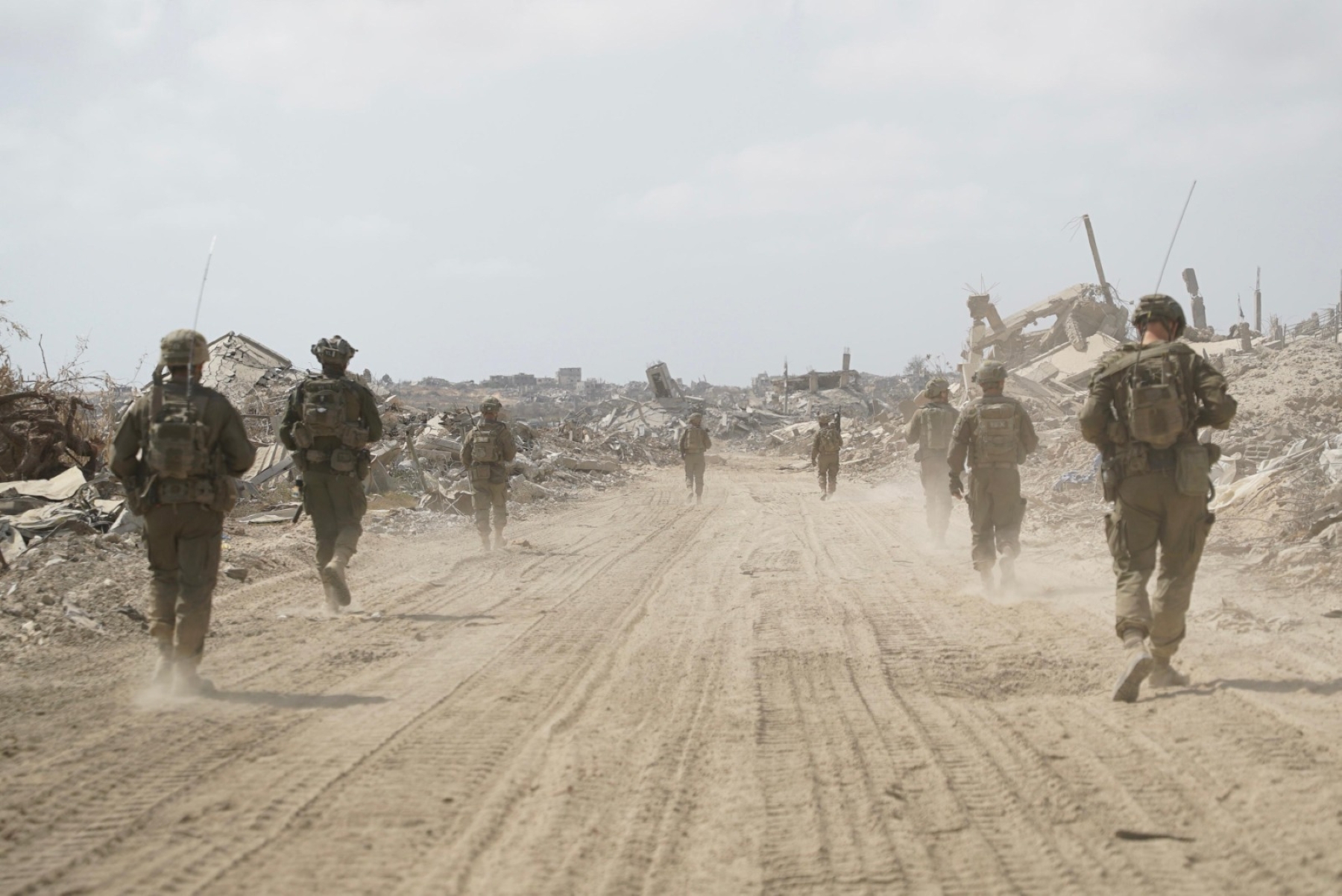
Beit Hanoun region (northeast Gaza Strip), July 2025. Soldiers from the Givati Brigade. The Hind Rajab Foundation (FHR) has filed a complaint in Argentina against Lieutenant Amit Nechmya, platoon leader of the Rotem Battalion of the Givati Brigade, for war crimes, as well as in Spain against Israeli Sergeant Mori Keisar, who belongs to the same brigade.
DF Spokesperson’s Unit / CCBY-SA 3.0
Sylvain Cypel – How did 7 October affect the Israeli army ?
Assaf David – Before 7 October, denial was the rule throughout Israeli society; the cruelty of the occupation for the Palestinians was utterly ignored. Besides which, the West Bank was people’s main concern. Gaza seemed far away. Nobody was interested in what happened there. Generally speaking, public opinion was much more concerned with the domestic judicial struggles, with Netanyahu’s efforts to curtail the powers of the Supreme Court. At that time a former Prime Minister, Naftali Bennett (far right), called Gaza “a pain in the ass”. Unpleasant but not important. Israel could “manage” Gaza, was the way he put it. The army went along with that.
The 7 October upended the whole society. The army’s initial powerlessness seemed incomprehensible to the population at large. No one saw it coming. The idea of “managing the conflict” disappeared. What followed was a catastrophe. The first quality one expects of a ruler is to keep a cool head. But after its initial panic, the army had a chaotic reaction which dragged the whole of society into an abyss.
S.C.– How do you explain that ?
A.D.– I think the Israeli regime has fallen into the hands of the messianics. From now on it is they who impose their vision – and this also affects the army. They are to Judaism what the Jihadists are to Islam. Judaism is instrumentalized to terrible ends.
S.G.– Two years later, what is the situation in the army today ?
A.D.–The best analysis was done by a lieutenant colonel in the reserve named Asaf Hazani. In a book published in January 2025, he wrote that the Israeli army has become an “army of militias” [see box below]1. He shows, among other things, that the decisions to commit certain acts are often taken by officers without the previous approval of their superiors or even against their orders. He also shows that superior officers sometimes do just as they please. Especially those who follow the messianic persuasion.
S.C.– How do you explain that state of affairs ?
A.D.–Israeli society has changed a lot. The two main factors here are the lack of any political solution with the Palestinians and the rise of religious nationalism. Taken together, these have led to a collective acceptance of the dehumanization of the Palestinians – and a delegitimisation of the political left. You put all that in a shaker and mix it vigorously and you come up with a very different army.
Normally, the General Staff, on 8 October, should have declared “Here’s what is forbidden. Anybody who breaks these rules will be prosecuted.” But the opposite happened. At the highest levels of the military, we witnessed destructive madness. How, then, can we be surprised at the widespread brutality and desire for total revenge among both soldiers and civilians ?
The wife of the Chief of Saff of the period, Herzi Halevi, told the media that on 7 October, when her husband learned what was happening in Gaza, he told her as he was leaving for General Headquarters : “We are going to destroy Gaza.” The country’s leadership, political and military, set the tone. After that, a lot of people threw oil on the fire. As a result, an insane cruelty, backed by public opinion, took hold of the army.
S.C.– Has there been any dissent between the political level and the General Staff or within the latter since 7 October ?
A.D.– There were internal tensions in the army. For example, between the heads of the ground troops on the southern front and the air force, which felt it was being asked to do too much. These differences weren’t made public until a year later. But the most significant crisis pitted the General Staff against the government, which didn’t want to stop the war to allow the hostages to come home.
S.C.– What was the army’s original objective, immediately after 7 October ?
A.D.– That’s hard to say. In the first days of the Israeli offensive, its spokesperson, Rear-Admiral Daniel Hagari, declared that it was more important to inflict damage on Hamas than to worry about the accuracy of the strikes. And very quickly the permitted number of Palestinian “collateral victims” was raised. To kill a single Hamas leader it became permissible to kill 150 to 200 civilians. But after a few months, the same Hagari declared that it was impossible to eradicate Hamas, “because you can’t eradicate an ideology.” As early as the third month, voices were raised in the general staff to prioritize the search for a political solution to this war. But the government wouldn’t hear of it.
S.G . – What did it want ?
A.D.– To crush Gaza and undertake its ethnic cleansing. That was the objective of the most powerful fringe of the government. The one that created the Directorate for Voluntary Resettlement of Gazans2. On this issue, the army is divided. Some of the generals clearly wanted to carry out ethnic cleansing. From the very first months what was known as the “generals’ plan” aimed to cause such an acute famine that the Gazan population would leave. In their minds, only the armed groups would be left behind and they would be easily eliminated. But another part of the General Staff opposed that strategy.
S.C.– You mentioned the importance of messianics in the Israeli army. What do they represent today ?
A.D.–Today that tendency is a majority in the General Staff. For a long time it didn’t count for much in the army, where the highest ranking officers were often products of the kibbutzim. But as time went by, the messianics developed an ideology, known today as “religious Zionism”, which has set its sights mainly on taking over the army.
Already they have won over a majority of the troops. With the passing of time, the demographic sociology has been completely overturned. Today, the General Staff is split between two camps, one “hard”, where the messianists are already strongly represented, and the supposedly more “liberal”. But the latter have already lost the internal battle. The military elite is already in the hands of the ethnic nationalists, with their very hawkish mindset, who are the biggest threat for the survival of Israel.
Besides the army, they now control the police, the internal secret service [Shin Bet] and the prisons. Personally, I was born in Kyriat Arla [an important religious settlement very near Hebron in the West Bank]. I know how children are raised there, in a terrible atmosphere of hatred towards Palestinians. When those young people go into the army they have absorbed that messianic education and that hatred. I don’t know how they can be stopped.
S.C.– The Israeli army depends a great deal on modern cyber weapons. Is that approach, especially its use of Artificial Intelligence (AI), dangerous ?
A.D.– On that question, I’m in two minds. Who committed the worst crimes in Gaza, high tech intelligence operators or the air force ? But yes, AI can be very dangerous. Today it dominates the field of intelligence, to the detriment of human intelligence. AI does what is asked of it as best it can. If it’s asked to commit crimes, it will propose the worst crimes possible. But if you’re a pilot, you don’t see anything of the damage you cause, anything of the children you kill so easily without ever seeing them. Which of the two is the most harmful ?
S.C.– Has the army begun to take stock of the war ?
A.D.– Yes, but it’s just beginning. When they have taken stock of the Israeli victims of “moral wounds” [an expression used by the Israeli army to avoid using the term “post-traumatic stress disorder”] these are going to turn out to be numerous and some of those who suffer from them are going to realize what they have done. We already know there have been suicides among the troops. And there are going to be more. And though there may not be so many killed in battle, it seems that there are many wounded. And all across Israel there is a general rise in brutality, in the streets and in the markets. Our children are going to live in a hyper violent, traumatized society, an atmosphere which will favor the rise of fascism.
Besides which, the army, dispatched to many fronts, is running low on combat troops. Many soldiers are not real combatants, they spent their military service manning checkpoints. Sociologist Morris Janowitz wrote that when an army takes on police duties, it grows weaker3.There is starting to be talk of enlarging our armed forces. Of lengthening the duration of compulsory service4, drafting more religious orthodox young men into non-combat units, etc. That said, the more religious men are conscripted, the more messianics we’ll have in the army.
.
S.C.– Israel keeps bombing Lebanon and Syria. Do you think it will attack Iran again ?
A.D.– Prime Minister Benyamin Netanyahu is capitalizing on international, regional and domestic chaos. And he will make every effort to fuel that chaos. If he can remove from their positions all those who oppose him, he will do so. Right now, it is Yifat Tomer-Yerushalmi, the army’s general prosecutor, who is in his cross hairs. He accuses her of “high treason” for having circulated a video of the rape of a Palestinian in an Israeli detention camp5.
If he can increase the amount of criminality in the Palestinian towns of Israel, he’ll do it. And if he can attack Iran again, he’ll do that too, if it benefits him. Israeli society and the usual centers of power are increasingly unable to stand in the way of Netanyahu and his entourage..
S.C.– At the same time, more and more Israelis say they are afraid that their country’s sovereignty is being whittled away by the Trump administration.
A.D.–That’s true enough. The real motivation behind the “Trump plan” for Gaza is greed. Netanyahu didn’t want it but he had to endorse it. For the very first time, US troops have a base camp inside Israel itself [near the town of Kyriat Gat, in the northern Negev] and the Gaza project involves the deployment of an international force, something which Netanyahu absolutely doesn’t want. But make no mistake about it: though it will be more complicated for him, Israel will go on calling the shots in Gaza.
"One way or another, the sword will win”
“An Israeli soldier, rifle in hand, stands before them [Palestinians sitting handcuffed on the ground] tearing pages out of a Quran. I went over to him asked why he was doing that. He answered with a sad look, the saddest imaginable: “I’m getting my revenge against them”(…) Those Qurans were already destroyed. Most of their pages had been torn out. He was just tearing them some more. He didn’t want to leave any trace of them. He felt that revenge was a feeling more important at this stage than depression, shock or exhaustion.
(…)
After 7 October, confidence in the system has disappeared [in the army]. Each individual withdraws into themselves and thinks only of themselves.(…) In one specific case, during a briefing prior to the departure of a military convoy for Gaza, the commander explained the regulations on opening fire. At which point, a lieutenant colonel from another division declared: “With all due respect, if I detect a threat, I don’t ask anyone’s advice.”
Excerpted from Asaf Hazani, One Way or Another, the Sword Will Win : Anthropology of a Time of War, Pardess Publishing House (not translated from Hebrew).
Translated from French by Noël Burch.
1Asaf Hazani, One Way or Another, the Sword Will Win : Anthropology of a Time of War (not translated), Pardess Publishing House.
2Announced in February 2025 by Israeli Defence Minister Israel Katz, the Directorate for Voluntary Resettlement of Gazans, charged with organising the “voluntary” departure of Palestinians from Gaza, was set up in March 2025. It is run jointly by the Ministry of Defence and the Prime Minister’s Office. The Deputy Director-General of the Ministry of Defence, Reserve Col. Yaakov Blitstein, was appointed to head it on 30 March 2025.
3See Morris Janowitz, The Professional Soldier : A Social and Political Portrait, The Free Press, Glencoe, 1960.
4Currently two years and eight months for men, and two years for women.
5Maj-Gen. Yifat Tomer-Yerushalmi, former Advocate General of the Israeli army, is accused of leaking a video showing Israeli soldiers raping and torturing a Palestinian detainee at the Sde Teiman prison camp in July 2024. The video was shown on Israel’s Channel 12 in August 2024. Forced to resign on 31 October 2025, Yifat Tomer-Yerushalmi was detained by the police on 3 November and later released to house arrest.