
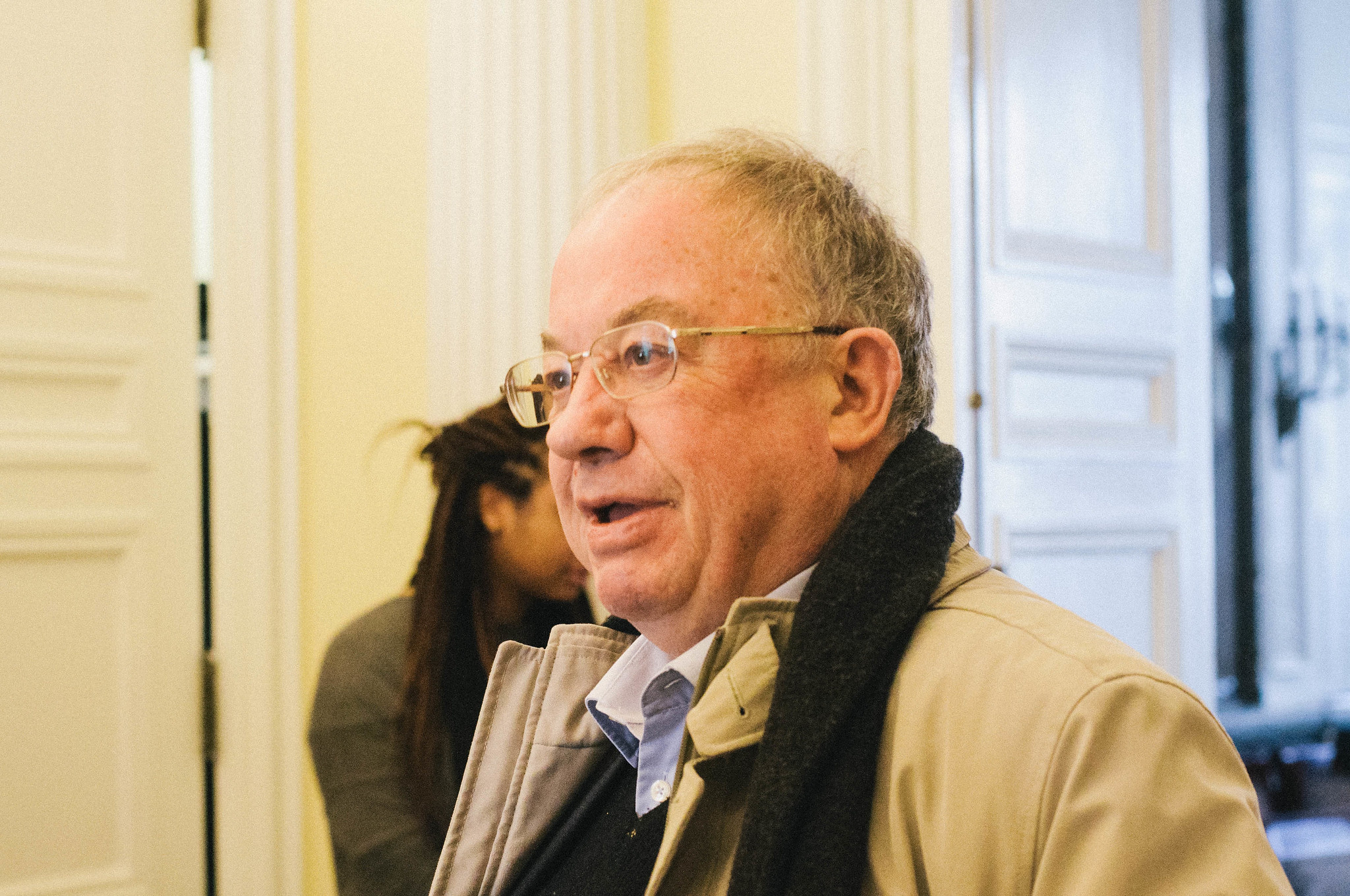
Boston, February 3, 2017. Olivier Roy, during a lecture at the Pardee School of Global Studies at Boston University.
Center for the Study of Europe Boston University.
In this interview with OrientXXI, Olivier Roy, political scientist and professor at the European University Institute in Florence, looks back at the heated con-troversy that followed the publication in November 2025 of a survey by the French polling institute IFOP on the religious practices of Muslims in France. He refutes several simplistic arguments and sheds light on the reasons behind the rise of Islamophobic rhetoric.
Orient XXI.–- The proliferation of media attacks on the religious practices of Muslims has been in lockstep with politics in France for at least two decades. Each media campaign is connected to a report or a parliamentary commission, or follows a terrorist attack. Each time a key word has been marshalled : “entryism”, “separatism”, “brotherhood” [a reference to the Muslim Brotherhood] “Islamism”, “Salafism”, “communitarianism”, etc.
In November 2025, when we had just commemorated the 2015 attacks and with local elections coming up in March 2026, a poll by the French Public Opinion Institute (IFOP) dealing with the religious practices of Muslims, claims to have observed a “re-Islamisation”, prompting many comments on the dangers of Islamism in France. What are your thoughts on that survey ?
Olivier Roy. – I analyzed re-Islamisation in my book L’Islam mondialisé (Seuil, 2009). It is the reconstruction of Muslim religious practices in a society where religion in general has either lost its cultural roots or never had them. It concerns primarily everybody’s practice, the orthopraxis, of religion. It is not really the result of a theological reformulation carried out by religious thinkers or philosophers, and certainly not the result of the political strategy of a political movement. The latter may attempt to take advantage of it, but will not control it.
Islam appeared in France as a consequence of the mass immigration in the sixties when French society was undergoing a massive de-christianisation and a religious deculturation. Hence a double alienation : a “new” religion appears while the traditional Christianity disappears from view. To which has been added the “Islamism” effect, which is to say, strictly speaking, the construction of Islam as a political ideology, a phenomenon specific to the societies of the Middle East and the Maghreb. Which has produced another form of visibility: the political threat and on the fringes, that of terrorism.
The public visibility of Islam in France, the disappearance of Christianity and the politicisation of Islam in the Middle East and the Maghreb, constitute three complementary levels. Any “return” of the religious – which is not a step backwards, but a reconstruction of religiosity – appears as fanaticism, even if it is celebrated by the far-right press when it’s a matter of Catholicism. A nun in full dress or a Lubavitch in sidelocks will not be looked upon more kindly than a Salafi in Muslim garb. The news reports on evangelical gatherings talk of nothing but religious fundamentalism and the huge assemblies of Protestant gypsies are viewed only in the context of “chicken thieves”.
O.XXI–. So there is no such thing as a Muslim specificity ?
In our de-christianized society, a moderate believer can only be someone who believes moderately. The problem is that sometimes believers actually really do believe. All the revealed religions believe they profess a truth which is higher than the law of men. The Pope rejects the distinction between believer and citizen and calls upon the faithful to act in society according to their faith. As Pope Leo XIV put it :
”Nor am I unaware of the pressures, the party instructions, the “ideological colonisations” – to quote Pope Francis’ apt expression – to which politicians are subjected. They need courage : the courage to say, “No, I can’t!” when truth is at stake. There too, only the union with Jesus – Jesus crucified! – will give you the courage to suffer for his name. He said it to his disciples : “In the world, you will have to suffer, but be brave: I have defeated the world” (John 12,33)1.
Being upset that a believer places divine law above the laws of the Republic shows how much our society misunderstands the meaning of faith.
Concerning Islam, the tension is even greater because it is associated with immigration and a political violence originating in the Middle East. Hostility towards Islam is shared by the anti-immigrant right and the anti-clerical left. Both will claim to speak in the name of “secularism” which has become an ideology rather than a principle of law as defined by the 1905 law on the separation of Church and State. Legal secularism in fact does not make religion a private matter : it regulates its practice in public. Which is why the law deals with worship (“les cultes”) and not with “religions”.
Thus today any public display of Islamic religious practice is seen as a manifestation of “Islamism”, a catch-all word which no longer has much to do with its original definition in political science. Any attempt to display a religious symbol in public is now perceived as a clandestine ploy to seize power. So everything involving Islamic religious practice is posited as a threat to society. It is that inability to think of Islam simply as a religion which explains today’s moral panic2.
I am not saying that Islam is “simply a religion”, every religion is more than that, but that religious ignorance combined with secularism can no longer understand religion in general.
O.XXI.– The IFOP poll was generally presented in the mainstream media as enlightening, ground-breaking, serious and useful. We heard little about the fact that it was commissioned by the magazine Écran de Veille, published by Global Watch Analysis, an agency which appears directly in line with the positions of the United Arab Emirates. What is the impact of this ?
O.R.– The people who commissioned that poll are indeed linked to the United Arab Emirates3 which is using this ploy to pursue its proxy war against Qatar by raising the bogey of the Muslim Brotherhood and by financing newspapers and think-tanks in Europe.
This is reflected in certain biased questions put to the respondents, using the word “Islamist” without defining it, putting Salafists, Wahhabis, Muslim Brotherhood and… Takfiris4, all in the same bag. They pretend to suppose that the respondents know what it’s all about, whereas I know some who think that a Muslim brother is just a fellow believer.
But casting doubt on the intentions behind a poll is not enough disqualify it. It can be a serious undertaking from the professional point of view. However, there have been countless serious polls for years and there is nothing original about this one. It simply creates more confusion. Olivier Galland5, a sociologist who works on youth, and Frank Fregosi6, a political scientist specialising in French Islam, both reacted to this survey by citing other equally serious studies that seriously qualify the conclusions of Ifop and Global Watch Analysis.
O.XXI.– What are its limitations in your view ?
O.R.– The problem isn’t so much with the figures as with the pollsters’ interpretation. On the basis of the same figures we can arrive at a conclusion diametrically opposed to theirs. According to the poll, 15 % of young Muslims believe that sharia law should prevail everywhere, 47 % that it should only apply in Muslim countries and 31 % that it should and could be adapted. Thus, instead of 46 % of non-integrated or badly integrated, we have 78 % of Muslims who think that one can live according to the principle of their faith in French society.
Every believer, Muslim or not, thinks his or her salvation is the most important thing; but that doesn’t mean you don’t have to obey the laws of the Republic. The profession of faith, praying, almsgiving, fasting at Ramadan, the pilgrimage to Mecca, defined as the “five pillars” of Islam are not “against the law” in France. Let us remember that jihad is not one of the pillars of Islam. And the reference to the sharia does not have the same connotation for Muslims and non-Muslims alike. The former think first in terms of the five pillars and of what is forbidden, haram, and permitted, halal, while the latter think of it as a strict code focused on punishment, especially the amputation of hands for thieves, or stoning to death.
The questions are conceived on the basis of the prevailing prejudices about Islam and not on the way Muslims themselves approach the problem. The latter will generally wonder, “Can I practice my faith in a French context ?”, rather than “is the Sharia compatible with the laws of the Republic ?”
The poll claims that 38 % of the respondents approve some of Islam’s principles. But which ones ? Giving to charity, not drinking liquor, showing solidarity with other Muslims, waging Jihad, promoting an Islamic Republic ? We’ll never know. The hodgepodge is such that the question is meaningless, but allows them to inflate the percentage of people whose loyalty to their country is considered dubious.
O.XXI.– Which data provided by the poll seem interesting nonetheless for a sociologist of religions ? What do they reveal which is surprising or counter-intuitive ?
O.R.– Paradoxically, if we skip the biased rhetoric of the commentaries, the poll shows rather the integration of practising Muslims, but an integration “as believers”. This is what seems incomprehensible for many commentators and attests to a misunderstanding.
The poll shows an evolution in people’s relationship to their religion, because this relationship is constantly being rebuilt as a function of their positioning in French society. The first generation of immigrants was no less devout than today’s, but their social marginalisation meant that their religious practices were invisible. What has changed today is the visibility of the believer and his or her demand that this visibility be recognized. And if the believer is more visible, it’s because he or she is more integrated: that’s what the fuss is about.
In the hasty conclusions which are sometimes drawn, the respondent’s life journey is forgotten; it’s the problem with these polls taken at a particular moment which do not realize that the respondents to previous polls do not correspond to the same social and generational categories. We are told that women of a certain age wear the headscarf less frequently than the younger generation. No doubt. But will the young women who wear it today, still do so as they grow older ? Religiosity must be seen as a dynamic process.
O.XXI.– How can this poll help to clarify generational issues ?
O.R.– Young people today, whatever their social origins, if not more religious, are at least more tolerant of religion. Religious practice has become commonplace. In colleges and secondary schools, it may also take the form of protest against an authoritarian, punitive secularism, characterised by imposing dress codes, a ban on discussing religion in class and the reporting of misbehavior to the administration (or to the police).Young people, who tend to be disenchanted and are in search of an identity, are likely to be deliberately provocative, by following different fashions: the abaya followed the crop tops, a favorite target of Jean-Michel Blanquer when he was Education Minister, who accused them of being anti-republican7. Those fashions sometimes have little to do with religion.
For fifty years now I’ve been studying, among other subjects, Muslim schoolchildren and students. There is a repeating pattern: the headscarf worn from 18 to 25, then abandoned when the young women enter the labor market; religious practices that are as fluctuating as the explanations given for them.
O.XXI.- How can we contextualize these transformations in believers’ relationship to their religion ?
O.R.– In the first place, we must emphasize the variety of these forms of “return to religion.” Since the 1990s all religions have experienced an identarian and normative wave. But today, with Generation Z8, everything is more flexible, less identarian, more closely linked to personal ambitions, often within the framework of small groups in search of meaning than in institutional structuration. We have to understand that Generation Z is more “mixed" than its predecessors for a very simple reason: the rise of the Muslim middle classes.
Too often, we remain stuck in the cliché of ‘Islamized areas’ in disadvantaged neighborhoods where Muslim youth are concentrated. However, while these zones of exclusion remain, a whole generation of young people is climbing the social ladder. A new Muslim middle class is establishing itself and encouraging its children to study. Today, it is this middle class that bears the brunt of Islamophobia.
It is no longer “separatism” which is the favorite theme of the anti-Islam headlines in the media and of many politicians, today it is “entryism”. And those who have entered are precisely those who have broken through the glass ceiling. They are executives, entrepreneurs, financiers, lawyers, journalists or professors. When they are practicing Muslims, they want to adapt their religious symbols to their new social condition in a milieu which is more mixed, socially but also religiously.
We observe among these young people an effort to construct themselves individually as Muslims. It’s a search for the self with a mix of identity and a concern for salva-tion. If Islam was communitarian, we would have an equivalent of the CRIF (Repre-sentative Council of Jewish Institutions in France) and a Muslim Chief Rabbinate. And possibly an Islamic party (under another name). Finally we would have a Mus-lim electorate which would vote as such. Actually, Muslims tend to vote for La France Insoumise, but not as a body. Paradoxically, it is the government which has been trying since the 1990s to organize Muslims by saddling them with an all-encompassing religious body, something which no one wants, not even its prospec-tive officials.
O.XXI.– So French society’s incomprehension of religious beliefs is compounded by its distrust of youth as a whole ?
O.R.– Young people’s new relationship to religion is disquieting. A recent special issue of the far right magazine Causeur (September 2025) was entitled “Le nouveau Péril Jeune” (“The new youth threat"). There was a time when the term “young person” was a euphemism for the young people of the working class suburbs and hence of young Muslim males. But now it is clear that it is the whole Generation Z that has become suspect : uneducated, ignorant, and either naive or fanatical. The massive criminalization of the demonstrations in support of Palestine is a conclusive illustration. You need only look at the activities of the Inter-Ministerial Committee for the Prevention of Delinquency and Radicalization (CIDPR), charged with countering attacks on secularism especially in schools.
They organize countless training courses (and courses for trainers), they appoint secularism monitors all over the place… and nothing happens. The message doesn’t get through and merely creates a form of generational distrust in reaction to the authorities’ insistence on a sort of pedantic dictation. Young people have moreover stopped reading the printed media or watching television. There is a generation gap which is treated only as a pathology and a threat to social order. Youth is the new dangerous class. And since the number of Muslims among young people is growing automatically for demographic reasons, the moral panic is amplified.
O.XXI.– How do these young Muslims fit with the ongoing dynamics among Christians ?
O.R.– We are witnessing in France a born-again Christian phenomenon9. Among Protestants, it has been going on for twenty years, but it mostly affects people with disadvantaged social backgrounds, immigrants or gypsies. They were seen in a way as Christian Salafis, committed to demonstrative and conservative reasoning.
However, with Generation Z we have today a born-again Catholic phenomenon which affects to a much greater extent the white middle classes. They are often confused with the young Catholics who do the pilgrimage to Chartres10, who tend rather to be following a family tradition. However, the phenomenon which affects Generation Z is much broader and more diffuse and does not have the systematic relationship with the far right and the so-called“traditionalist Catholics”. However, today, the middle classes are more mixed than in the past and hence there is more contact between the various “born-again”. These interactions are quite visible, for example with the Muslim children whose parents send them to private Catholic schools.
What is new is the emulation rather than the rivalry with Islam: there is a parallelism in the practices of fasting. Observing Lent was probably the religious obligation which disappeared most rapidly after Vatican II, whereas mass, confession, and the Eucharistic remained at the heart of Catholic practice. But today one sees young neo-Catholics observing Lent once more, in parallel with Ramadan - it’s all the easier when the dates coincide. The young Muslims attending Catholic schools are in contact with a practicing Christianity and we observe a mutual tolerance. On 5 November 2025, the pupils wearing headscarves in the galleries of the National Assembly whose presence shocked certain MPs had come there on an outing with their Christian school. They were defended by the administration of Catholic education in France.
O.XXI.– Do you see any real differences ?
O.R.– The difference with Islam is that this renewal of Catholic spirituality is occurring against a background of continuing de-christianisation: there is an increasing number of adult baptisms, but the overall number of baptisms is dropping as is the number of people going into holy orders, which means that newly-baptized adults are not becoming priests.
One might think that the opposite is true with Muslims: that the increased practice would go along with a rise in the number of vocations. But this seems not to be the case : the vocation to become an imam appears quite rare. They continue to be recruited either in Muslim countries or among the self-taught. Little prestige is attached to an activity which is poorly paid. Of course there is a debate about the training of imams as well as systematic obstruction of the opening of Muslim schools. But if there really were a return to “institutional” faith among young Muslims, which is to say a determination to work towards a genuine religious community, then there would be more college-educated imams. Which is not the case. Instead we see familial transmissions: the new imam is the son of the previous one, indicating a “patrimonialisation” of the religious undertaking rather than a communitarian mobilization.
So we see that the apparent increase of religious practice among young Muslims does not lead to an institutionalization of Islam. We remain quite largely within the logic of Saint Augustine’s “two cities” where the believer and the citizen are two versions of the same person in two worlds, two cities, which intersect but do not overlap. This is what the secularists cannot understand : you can be totally devout and a perfectly good citizen because these two worlds exist said by side and are not in competition. As for the argument according to which there is no separation between religion and politics in Islam, it has always served to instrumentalize religion for political purposes rather than the other way around.
Translated from French by Noël Burch.
1Quoted by the Bishop of Créteil, Mgr Dominique Blanchet, in a speech given at a private audience before a delegation of local French officials from Val-de-Marne, on 28 August 2025.
2The concept of “moral panic” was formulated by the sociologist Stanley Cohen in the 1970s to describe disproportionate collective reactions to the appearance of individual minority practices which, despite their minority status, were seen as deviationist or a menace to society.
3Accused of supporting opposition movements and especially the Muslim Brotherhood, Qatar was subjected to a harsh embargo by its neighbours from 2017 to 2020. Saudi Arabia, and even more so the UAE, imposed a blockade and mobilised various international mechanisms to stigmatise Qatari foreign policy, notably in Europe and Palestine. Reconciliation under Saudi Crown Prince Mohammad Bin Salman led Qatar to align its foreign policy with that of its neighbours, though occasional tensions persist.
4The “excommunicators”, Muslim extremists who condemn as apostates all those who do not share their vision of Islam.
5Olivier Galland (with Gérard Grunberg) “Sur la “réislamisation” de la jeunesse musulmane“, Telos, 25 November 2025.
6«“Musulmans de France, religiosité, islamisme : les chiffres contestés de l’enquête Ifop”, The Conversation, 26 November 2025.
7On RTL, 21 September 2020, the former Minister of National Education had this to say on the subject of crop-tops : “You don’t go to school dressed for the beach or a night club. You go to school properly dressed...Everyone understands that you come to school dressed in a republican manner.”
8The generation born roughly between 1995 and 2012.
9In this context, the term applies to the newly-baptised or to those who as adults rediscover a faith they have laid aside for a while.
10The pilgrimage of Our Lady of Christianity, also called the pilgrimage of Chartres, is a traditional Catholic pilgrimage from Notre Dame in Paris to Notre Dame in Chartres. It takes place annually in the weekend of Pentecost.