
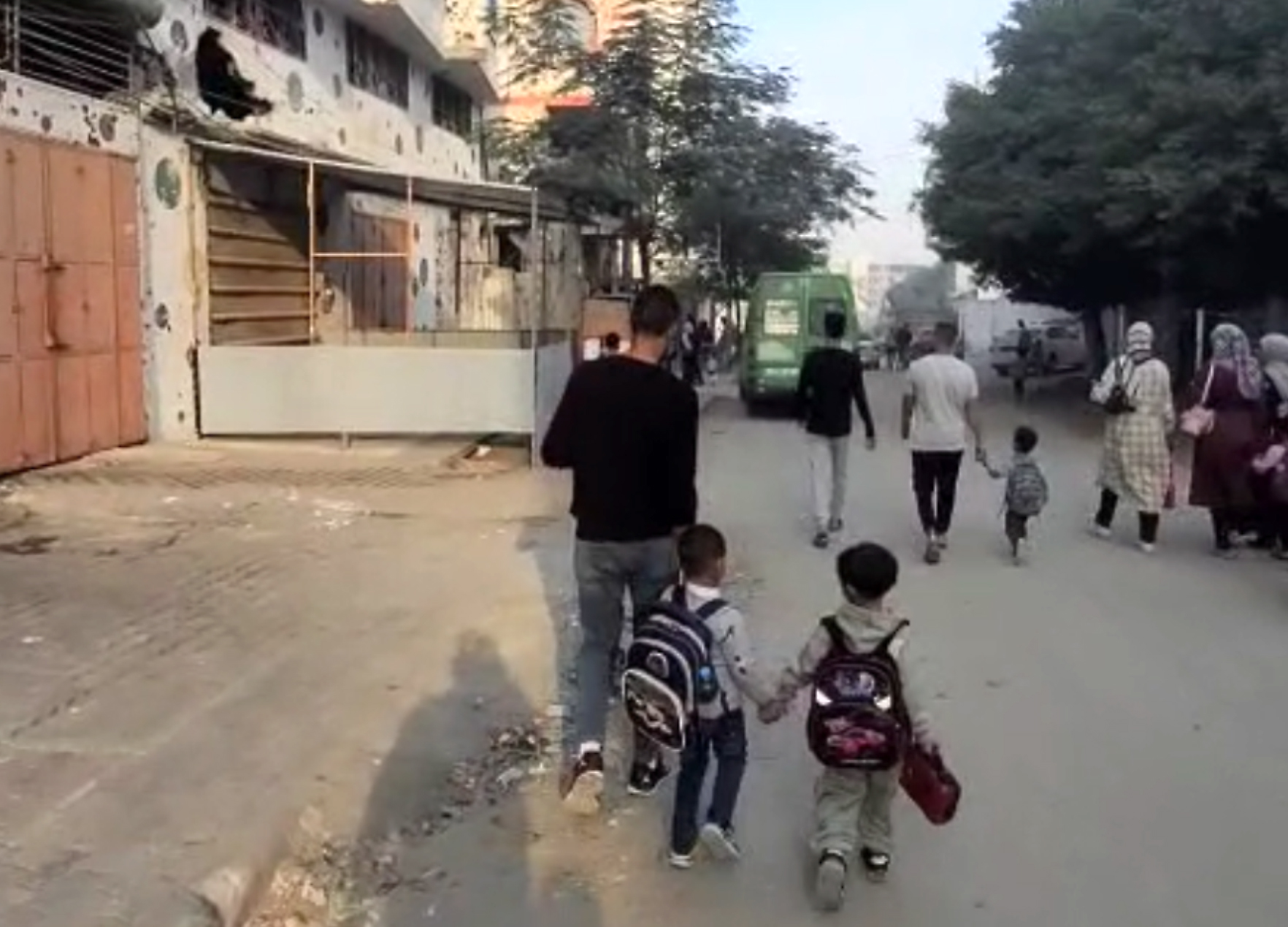
Gaza City, November 2025. Walid (right), Rami Abu Jamous’s eldest son, returns home.
Rami Abou Jamous has been keeping a diary for Orient XXI since February 2024. He is the founder of Gaza Press, an agency which provided assistance and interpreting for western correspondents, but in October 2023 he had to leave his apartment in Gaza City with his wife Sabah, her children and their three-year old son Walid under threat of the Israeli army. They sought refuge in Rafah, then in Deir el-Balah and later in Nusseirat. After another move caused by Israel’s violation of the cease-fire on 18 March 2025, Rami and his family returned home on 8 October 2025.
NOVEMBER 13, 2025
Last Wednesday was Walid’s first day of kindergarten. I had no choice of where to send him; only one school has opened in our neighborhood of South Rimal. The day before, I told him : “Now you’re a big boy; you’re going to school to learn. You’ll be able to play with new friends. There will be games, slides, and swings.” He was very happy to go to school. I bought him a backpack decorated with a red car, because he loves cars. I also bought him a notebook, a pencil, and a lunch box, which we filled with chocolate, a sandwich, and water.
The school isn’t very far from home, so I walked him there with our neighbor Hassoun’s son, Faraj. We took Abu Hasira Street, a very well-known street in Gaza, named after a large family of fishermen who ran a famous fish restaurant frequented by Gazans and foreign visitors alike. The family has lost hundreds of members, killed by Israel’s occupying army. The street itself has practically disappeared.
As I was walking with the children through a field of ruins, between two piles of rubble, Walid asked, “Who did this ?” When he asks questions like that, I always answer, “It was the police.” I think he’s still too young for me to explain the Israeli occupation of Palestine to him.
The school is called Al-basma al-jadida (The New Smile). A lot of people stood in front of it. Dozens of parents had come to accompany their children, of various ages—it is also a primary school. It was 7:30 in the morning and still dark. Children were crying. Walid was worried, but I reassured him, and he was finally convinced to embrace this new experience. The building had been bombed; we could see pieces of armored vehicles and walls that had apparently been rebuilt. All the kindergartens, schools, colleges, and universities have been partially or completely destroyed by Israel. Those still partly standing are being used as shelters for displaced persons.
We discovered that classes were being held in the basement. The teacher came to take Walid by the hand. I accompanied them. Downstairs, everything was dark; it looked like a large prison. Walid found himself in a room with about thirty other children. Before, kindergarten classes had about ten children, but today there are still too few schools, and all those who can afford it, like me, are eager to send their children anywhere.
Many children were crying. Walid was a little shocked, not quite understanding why he was in this scary place. He looked me in the eyes as if to ask, “But Dad, is this the fun experience you were talking about?” I told him, “Everything’s fine,” and he repeated it: “Everything’s fine.”
Of course, this overcrowded school in the middle of the rubble is not fine. But Walid is lucky that his dad can afford to pay for any kind of kindergarten at all, where he can make friends and start to understand the concept of studying and learning, while hundreds of thousands of children are on the streets, doing odd jobs in the markets to help their parents, queuing for a little water, for the little humanitarian aid available. Most children in Gaza have grown up too soon.
The new schools in Gaza are private, and their scarcity drives up prices. I had to pay 300 shekels ($94) in registration fees, plus 170 shekels ($53) per month. That’s a huge amount of money in Gaza, which most people can’t afford. Parents borrow money where they can to pay tuition fees, because education is very important to us. This is part of Israel’s plan: destroying everything that belonged to the public sector, enabling the internationalization and privatization of the Gaza Strip that will create Donald Trump’s “Riviera.”
In the health sector, public hospitals, which have been either completely or partially destroyed, are being replaced by field hospitals run by international NGOs. The same goes for food and medicine. Israel only allows private sector traders to enter, not free humanitarian aid. As a result, the markets are full of things that are not really necessary: ketchup, a thousand kinds of chocolate, fruit juices, even sodas. But protein, chicken, meat, and eggs are scarce and sold at exorbitant prices. There are vegetables and fruits, but they are beyond the reach of the majority of the population. In our country, the average family has six members, and people cannot afford this kind of expense.
Practically nothing can be found in pharmacies. I searched in vain for cough syrup for my seven-month-old son Ramzy. Patients with chronic illnesses have practically nothing to treat themselves with. Many of those with cancer die in silence and in great pain. From the outside, it may seem that life is returning to Gaza, but in fact, it is not life. It is only non-life that is beginning again. We cannot speak of life if the pillars of life—education, health, housing—are not in place. It’s impossible to rebuild or even repair houses and apartments that have been damaged. All my windows are broken, but I can’t find glass to replace them, only plastic, and even then, I can’t find the right kind of plastic. Even a tent is an impossible dream. People continue to live on the streets, under tarps, and to cook with wood. They use dirty water. Drinking water is becoming increasingly scarce.
Israel says, “Look at the markets, cafeterias, grocery stores—we’ve brought in everything you need. There’s no more famine in Gaza.” But that’s just a facade. The reality is that about 85 percent of the population lives on the streets, 85 percent of children don’t go to school, and 85 percent of students don’t go to university. Even worse, 90 percent of the population has no income and depends on humanitarian aid—aid that is not coming in, Israel claims, because “Hamas has violated the ceasefire.”
No one mentions that it is Israel that has not respected the ceasefire so far, nor has it allowed in the daily humanitarian aid trucks we need; it has not allowed in what we need for reconstruction, not even tents. The same goes for everyday life: blankets and clothing for adults and children, for instance. Meanwhile, Israel bombs whenever it wants, on the pretext that someone has approached the “yellow line,” which prohibits access to more than half of the Gaza Strip, or because there is a “danger” somewhere for the occupying army.
Let us repeat : Israel is not respecting the ceasefire. International NGOs are constantly alerting the world that humanitarian aid, medicines, and medical equipment are not entering Gaza in sufficient quantities. But the world is looking the other way. It had already turned a blind eye to war and genocide. Now, it seems, it wants to close the case, to pretend everything is fine.
I don’t know when this will be repaired, but the Palestinian people are trying, each time, to rise from the ashes like a phoenix. Israel still plans to make Gaza unlivable in order to drive the Gazans out. But if the international community showed some commitment to ensuring that humanitarian aid and, above all, construction materials can enter, we would rebuild the universities. And we would regain Gaza’s main asset : education.